These are the words you skim for and stop at when you finally get that email.
On my second attempt to acquire funding for my Community Project, I took feedback and made a lot of adjustments from this version that I think dramatically improved it. I had a stronger vision and a clearer focus. But, no luck. I will revise and reapply in the new year, and I think that Canada Council will like to see two things from me:
Some of the work, completed. The format of this project is difficult to explain and will be so easy to demonstrate when I’m 10-15% into it.
An exhibition lined up with a gallery. I think this is a big part of why this grant proposal was funded.
In the meantime, the content of this grant may prove useful to other artists seeking funding or simply people who are interested in what I’m working on! I submitted this proposal in September 2026. The category was “Artist Creation Grant”. My application included my CV, which you can find here, with all activities up to mid-2026 included. The images interspersed usually all go together at the end.
Don’t let that stop you from dreaming up gorgeous futures.
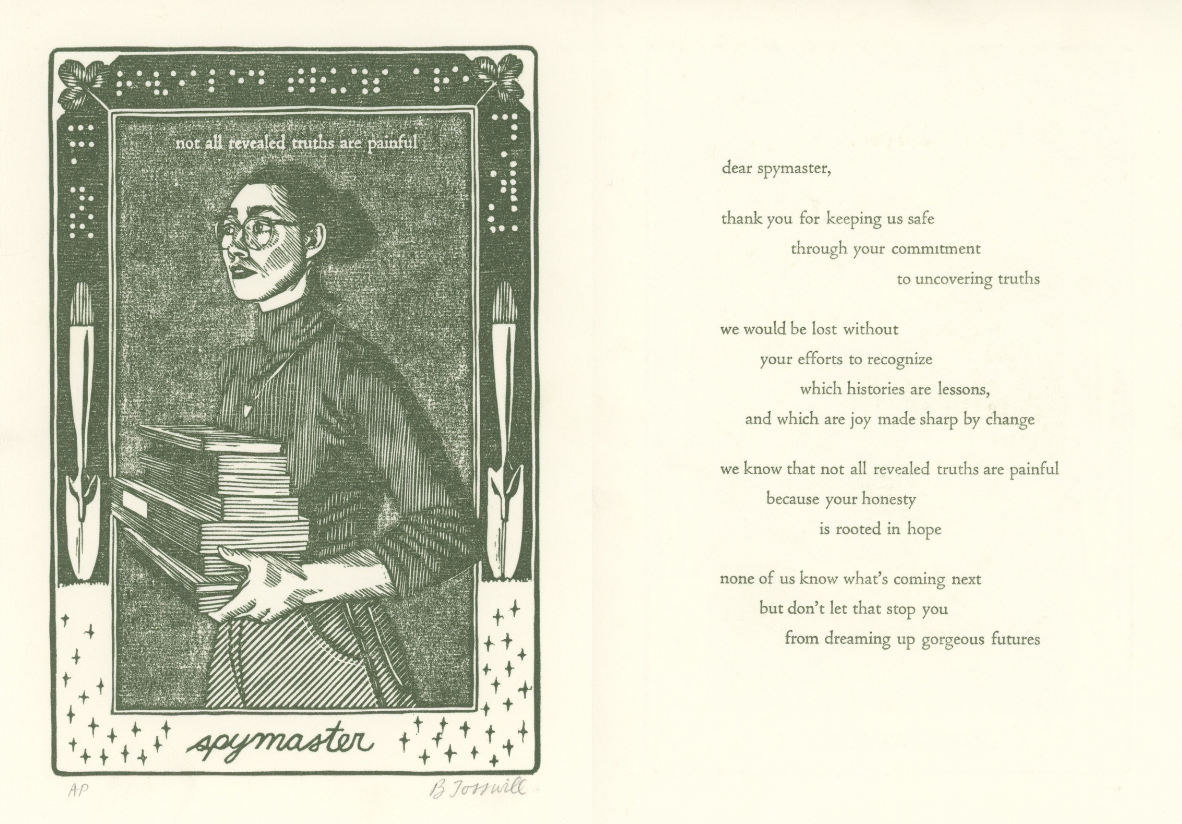
“Spymaster”
linocut print and typeset poem (referenced in application) 5x7” double-sided 2024
artistic experimentation
artistic research
artists and community collaboration
creation of artistic work
1 sentence project description:
A printmaker will create a library of modular linocut prints to be combined into neighbourhood compositions that emphasize the magic of third spaces (1-year).
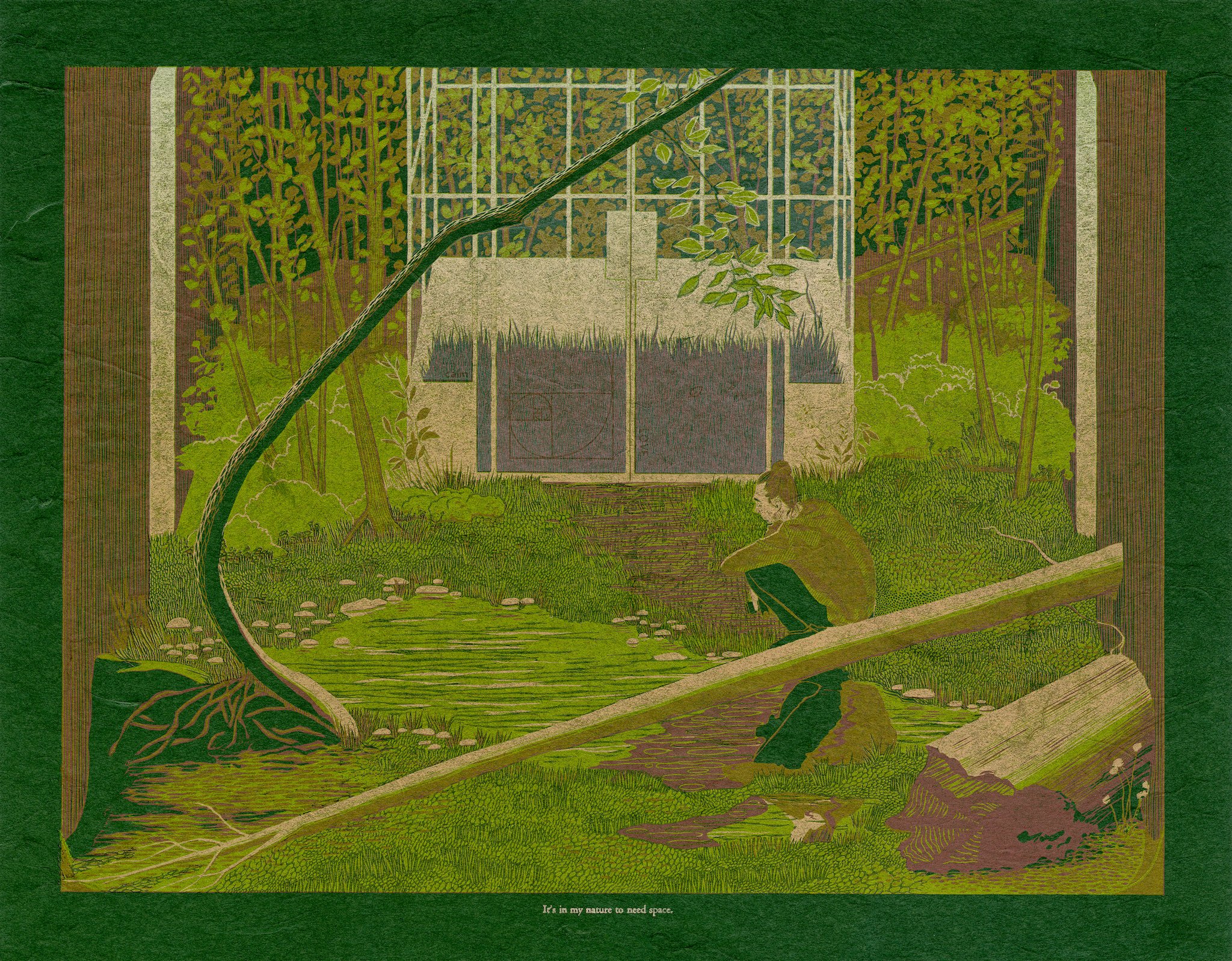
“It’s in my nature to need space”
linocut print (demonstration of printing on coloured paper) 16x12” 2023
Activity Description
I am a printmaker and mixed-media artist based in Edmonton, Alberta. My deeply analog art is driven by conversation and social interaction. Two of my recent and notable bodies of work are The Comfort House Project and Romantic Tensions. Both are grounded in linocut printmaking and elevated with low-relief, interactive wooden sculpture. Detail and craftsmanship are as important to me as storytelling.
For The Comfort House Project, I asked 11 people how they seek comfort, and why, and whether they feel they deserve it, and then I imagined and rendered spaces that would be specifically comforting to them. 11 prints tessellate into a single house composition, which exists in an edition of 9. Throughout this 2-year project, I pictured it in the teen section of public libraries, where young readers are learning coping mechanisms that will last them throughout their lives. Four of the houses live in private collections; no libraries yet.
Romantic Tensions is another 2-year project that recently culminated in my first solo show at dhARTworld. The research for it was more introspective; its stories are based on my romantic history. Each artwork consists of a linocut print and a wooden “theatre”/frame that expands it visually and conceptually. Some of them turn, others have opening doors, or tiny books to rearrange. Each artwork is meant to spark conversation and contemplation of the viewers’ own relationships, past, present, and future. The title of the exhibition references the challenge of balancing love and life, independence and support, and the fig tree decisions we make about the kind of life we want to live.
If my previous projects have focused on the themes of Comfort, Friendship, and Romance, this will be Community. I’m going to linocut print an image library of objects in isometric perspective and then recombine them in different neighbourhood compositions. There will be painted elements, and collage, and the project will take inspiration from walkable neighbourhoods and third spaces and how environments inform relationships.
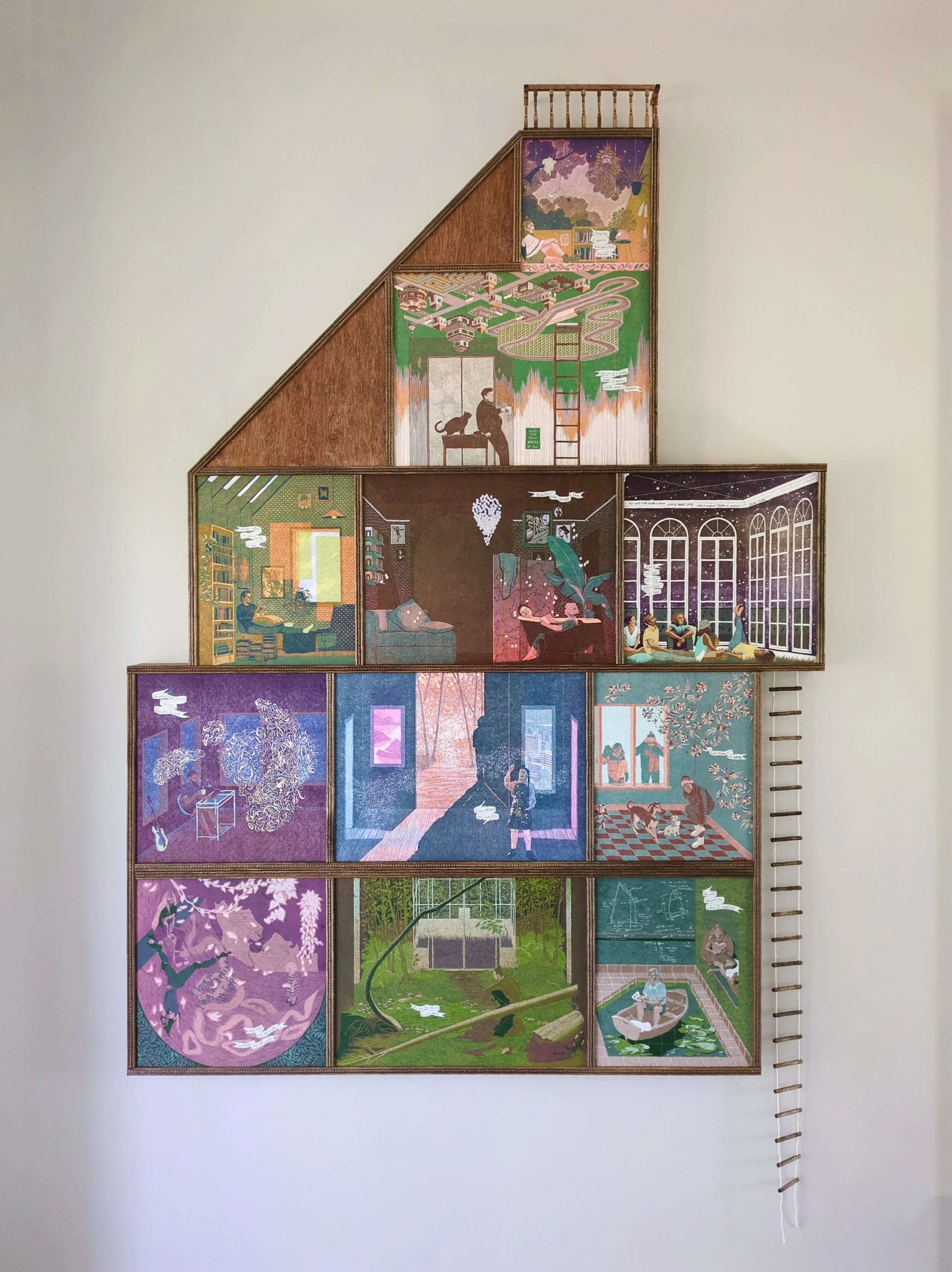
“The Comfort House Project: stay as long as you like”
multimedia artwork, predominantly linocut. 44x59” 2023
I’m moving in a month (within Edmonton) from Whikwhentowin to Desrochers (from super walkability to someone else’s suburban dream). My direct observations of neighbourhood life in both places will be part of the thesis of this work (still tbd). I’m going to earnestly try to meet people and make friends in my new neighbourhood, because I have observed over and over how physical proximity enables social frequency, which fosters emotional closeness. As always, my personal fascinations and my creative practice run parallel paths.
In my work, linocut is constant and other media shift to suit the expressive needs of my projects. I was keen to learn printmaking thanks to contagious enthusiasm, and it’s practical from a professional arts standpoint because of its multiplicity. But ultimately, the last ten years of practice have rewired my brain so that even in other media, I think like a linocarver with access to a letterpress. The letterpress I use is a Vandercook Proof Press, a 65-year-old machine that prints quickly, accurately, and allows me to manipulate ink and pressure in a nuanced way. The press lives at SNAP Printshop, a creative non-profit in Edmonton that is the foundation of my creative community.
Within printmaking, I practice an approach called “linocut reduction”. It involves carving a single block of linoleum in multiple layers, printing one colour at a time and destroying the block by the end. It is meticulous work, requiring a great deal of patience, planning, and colour theory. The resulting edition is inherently limited. This limitation aligns with my creative priorities; it resists perfectionism and mass production. It is art that feels materially like the past and the future.

“Branching Out”
Interactive multimedia artwork (containing 3 of linocut print “Moving (on) Day”. This is an example of the ambition I am trying to cultivate in my creative practice. Part of Romantic Tensions solo show. 36x54” 2025
Since I am committed to printing with a Vandercook, I am limited by scale. My max print size is about 12x16”, and I have been exploring making big work by piecing out one image (fig 1), or making an artwork that consists of multiple, pre-planned images (fig 2). I have been dreaming of true modularity, so I’ll be using isometric perspective. This places all objects on a triangular grid and gives the illusion of three-dimensional space without far objects getting smaller or near objects getting bigger. Lots of architectural drawings are isometric. So are some video games (I was addicted to The Sims as a teen, which is ironic considering its suburban messaging). If I make my linocut library of things isometric, I can rearrange them endlessly.
What’s interesting about me (a printmaker with the word “analog” in all of my artist statements), working in this way, is that I’m sharing logic with video game designers. I think this visual cue, combined with everything being literally cut and pasted, is going to evoke nostalgia for a huge group of people. Besides The Sims, some of my visual and conceptual inspirations are “The Library of Babel” by Jorge Luis Borges (short fiction about a hexagonal world inhabited by “librarians” who seek meaning in an endless array of books full of mostly nonsense), and the paintings of Spanish artist Cinta Vidal (playing with perspective and gravity in a super compelling way, with aspirational use of light and colour).
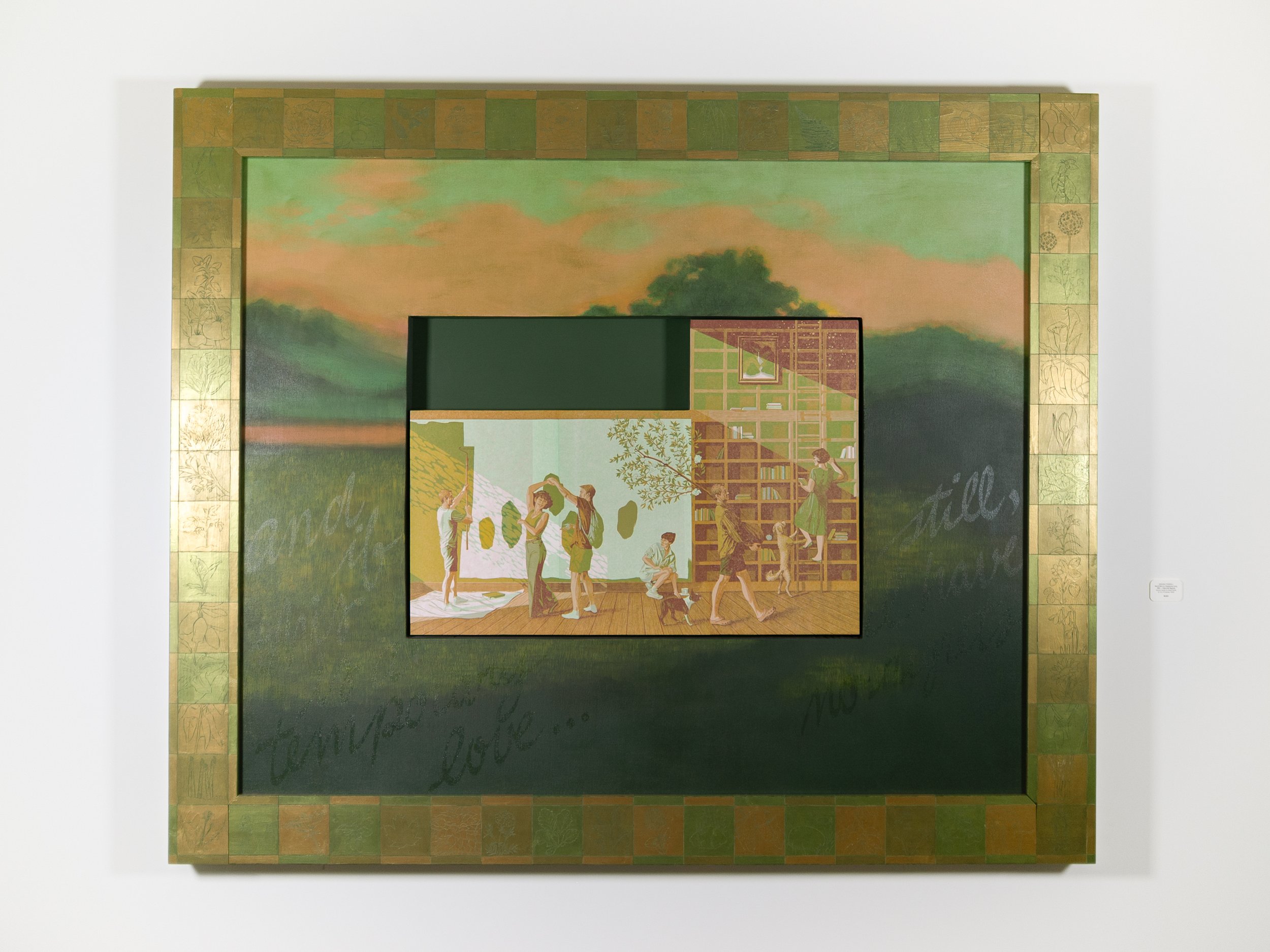
“And if this is a temporary love… still, I have no regrets”
multimedia artwork with linocut, acrylic painting, and hand-carved frame. Part of Romantic Tensions solo show. This combination of print and landscape painting is something I want to explore more. 62x74” 2026
I’ve begun a list of things to include in my linocut print library:
- trees & bushes
- book boxes & mailboxes
- people playing chess, cards, catch (other sports)
- people having a picnic, eating ice cream
- people walking dogs
- coffee & lemonade stands
- an ice cream truck
- independent commercial spaces
- murals (being painted?)
- sidewalk chalk
- fountains
- public bathrooms
- sandwich boards
- stairs
- sidewalks
- water
- green space & community gardens
- birds and other urban wildlife (hares, Canada geese, and magpies)
I will draw, carve, and print 100 objects in editions of 10-100 (fewer coffee shops, more trees). The compositions I make with them (>10) will also include painting to connect the objects and fill in awkward gaps, and coloured pencil to make lighting and shadows cohesive (fig). I really enjoyed the play of printmaking and painting in my recent work (fig). There is more to explore there. I plan to print each image in two colourways: one to evoke daytime and one to indicate evening.
I want my work to inspire people to take action. Here is an imaginary place, community, or relationship. Do you want parts of your life to resemble this? What can you do, right now, to make that more likely? There are certainly big-impact actions a person could take to build community: organize groups, plan events, etc. But I suspect that being a good neighbour, whatever that means to you, might be enough. I’ve learned by walking my dog the kinds of joyful connections that can be built through small talk and repetition. It’s not so much about effort as awareness. My poem Spymaster (2025) ends with the line, “none of us know what’s coming, but don't let that stop you from dreaming up gorgeous futures."

“Labelled: Aquarius”
multimedia artwork with linocut print at centre (my first foray into this theatre-frame format) 14x20” 2024
What is your capacity and experience to carry out the activities?
I am just wrapping up my first solo show, an exhibition that represents two years of work within the theme “Romance”. Romance is my third major theme, following Friendship and Comfort. I think of my proposed project as beginning the theme “Community”. I worked on Romance for a year before I booked my show and acquired a grant to finish the work. For Community, I’m seeking a grant to support the first year of research and creation. I will be taking this year to apply to exhibition opportunities and forge gallery relationships to culminate in a major show 2-3 years from now.
I have complete confidence in my ability not only to carry out my current plan but also to expand on it as it progresses. As a creative researcher, I have developed soft skills to engage community members on an individual level and by word of mouth. As a printmaker, my technical skills are at an expert level. As a visual artist my style is established with plenty of room for exploration. My colour theory is getting better and better. I don’t know if these skills will be required, but I am a very competent sewist and a promising carpenter.
After 10 years of being a practicing artist (5 years devoting myself to it full time), I’m getting a handle on the cycles: applications, exhibitions, granting, networking, etc. Last year, I applied to 13 opportunities (grants, exhibitions, awards) and hosted 15 studio visits. This year, I will apply for 20 opportunities and host/attend 15 studio visits. I’m not increasing the latter because, as I migrate from a community studio in a central location to a garage studio in the suburbs, these visits will take more effort and planning.
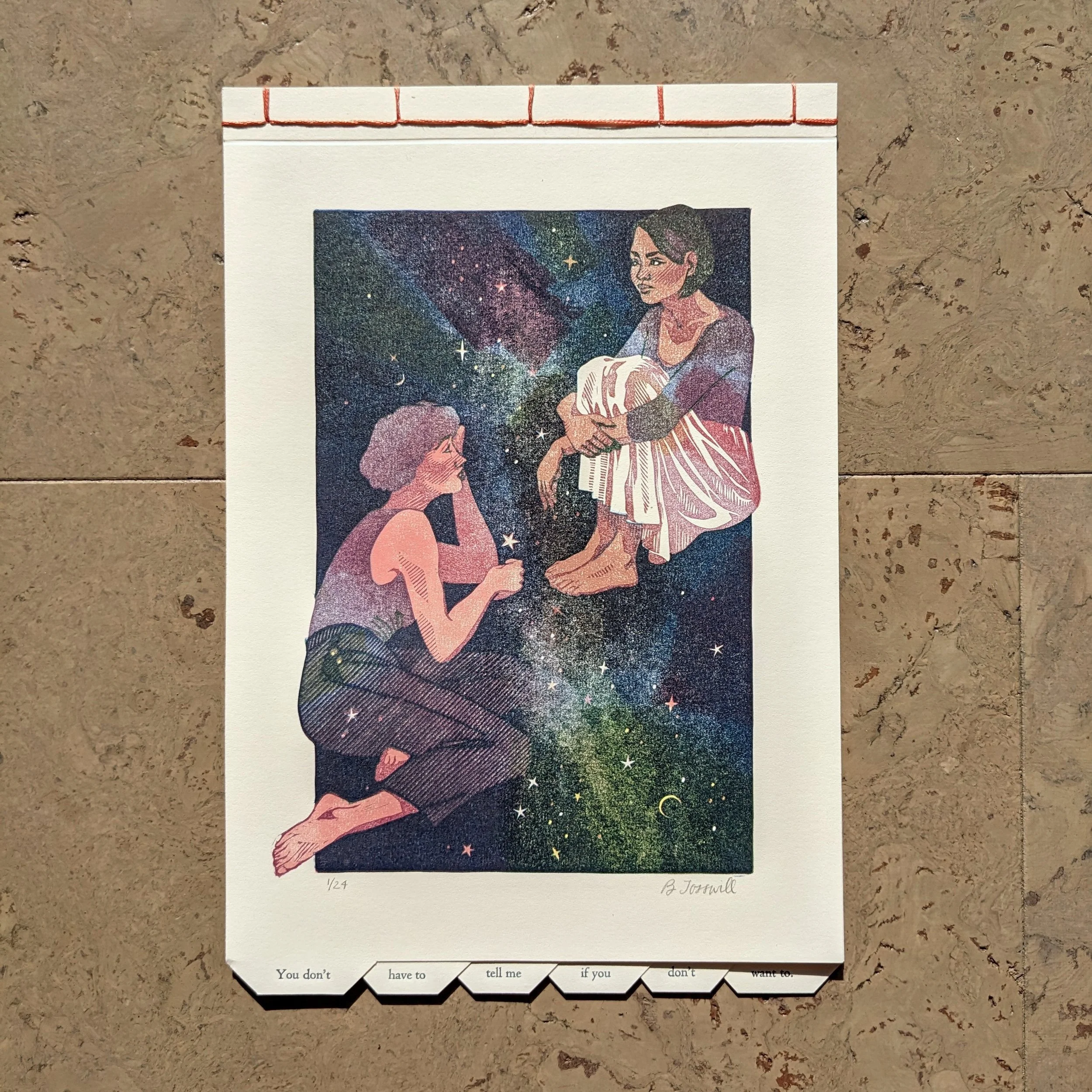
“You don't have to tell me if you don't want to”
artist book with linocut and letterpress printing (each consecutive page has one fewer layers of the linocut reduction, flattening and reducing detail in the people depicted. The poem on the final page expands on the meaning of the title.) 7x10.5” 2023
What is your project timeline? Provide important milestones.
Months 1-2: Make thumbnail sketches of at least 100 objects, expanding on the list above. Make one large isometric grid drawing on my studio wall and begin rendering specific objects in the correct scale. Trace the objects to create linocut prints. Working from one central drawing will help keep scale consistent. Aim to finish the first linocut print within month 2. This feels slow, but I want to take time with the drawing stage and iterate to create the strongest possible imagery.
Months 3-6: Continue to develop the drawing and the linocut prints. As the proof of concept clarifies, invite audience participation: What unassuming part of your neighbourhood makes it feel like home to you? Does anyone want to suggest or even design an object for me to translate into linocut? Begin applying for exhibition opportunities. Goal for 6-month mark: 30 objects.
Months 6-9: Continue to develop the drawings and linocut prints. Cut out and play with compositions of the finished objects to identify missing parts and to unify the colour palette. Don’t glue anything yet. Let the process unfold, don’t rush it. Continue applying to exhibition opportunities.
Months 9-12: Continue to develop the drawings and linocut prints. Start with 2-3 small compositions around 20x30 inches. Invite creative friends to play with my library of images and see what comes of it. Make at least one really big composition (8 feet wide). This part feels the least defined right now because the earlier stages will really determine what is possible in terms of scale and quantity. I can also see this timeline stretching: I could continue to make new objects and compositions without using up all the original objects for a prolonged period of time.

“You’re Doing Fine”
linocut print on handmade paper (embodies a lot of the video-game aesthetics I’m planning to use: coloured background, Ghibli vibes, a small text element) 6x8” 2022
Applying for exhibition opportunities:
Since I moved to Alberta in 2019, I’ve been building relationships with curators, gallerists, non-profit spaces, and collectors. My comfort project is currently part of TREX, a travelling exhibition that is installed in schools, libraries, and other public spaces in rural Alberta. This would be a perfect setting for my upcoming work, though I don’t know if they’ll take me two cycles in a row. I have extremely close ties with SNAP Gallery (it’s a print studio AND a gallery) and had two exhibitions there in 2020/21. I’ve been working on diversifying my CV for a few years, but this work and its experimental approach to printmaking might be perfect for them. Their annual open call is usually in the late winter. I will also submit to other print centres like Martha Street Studio (Winnipeg) and Atelier Circulaire (Montreal).
This year, in a long-shot plot to win a printmaking residency, I submitted my work to the Royal Scottish Academy’s 200th Annual Exhibition in Edinburgh. Although I failed to win the residency, my work was acquired through a purchase prize and won an award. This seems like a promising strategy which, in hindsight, I can see peppered through my CV. These shows tend to require an application fee of $10-30, which I have personally found to be a worthwhile investment. While some of my applications this season will go to non-profit galleries and public art spaces (mostly free to apply to), some will go to juried group shows and require an application budget.
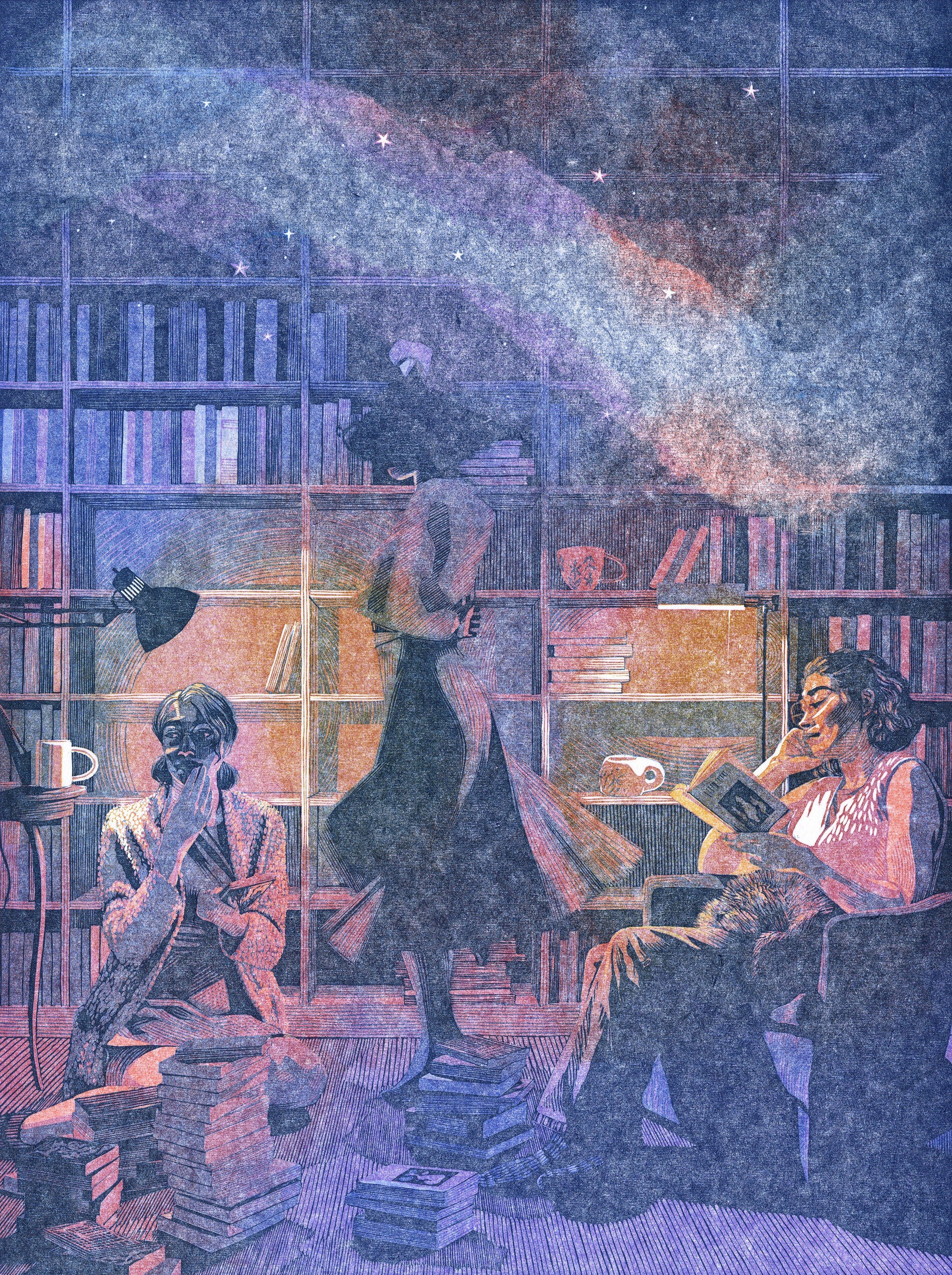
“Crushing Softly”
linocut print (there is no hand-colouring in this, just 4 layers of reduction carving and printing from a single block. It demonstrates my current mastery of this medium, though there is always more to learn.) 12x16” 2024
Is there other information that will help us understand your application?
Alberta has two big personalities and they are divided fairly cleanly along the lines of urban and rural. I identify pretty strongly with the urban side, so I’m hesitant to describe either group. Two years ago, I started seeing my opposites-attract partner (the person I’m moving to the suburbs for), a blue-collar healthcare worker who grew up very rural with a high school graduating class of twenty. Together, we are a bridge between these cultural attitudes. Last year I spent Canada Day in Breton (population 567), and while I felt a bit like a foreigner experiencing a new culture, I appreciated the closeness of the people, their willingness to celebrate. On the flip side, I have brought my partner to numerous art events and introduced him to my community full of immigrants and queer people. All of this gives me hope. I don’t know exactly what thesis will emerge from my research and creation, but I want to remember that few people have the same neighbourhood ideal, and trying to find perfection by taking averages is a principle of mass production and is unaligned with my values.

“Love you, bye”
linocut print, 5x7” 2023
